01
Clarity
See what’s assumed.
Get a clear view of the rules, data, and assumptions behind any strategy.
 CinderVex
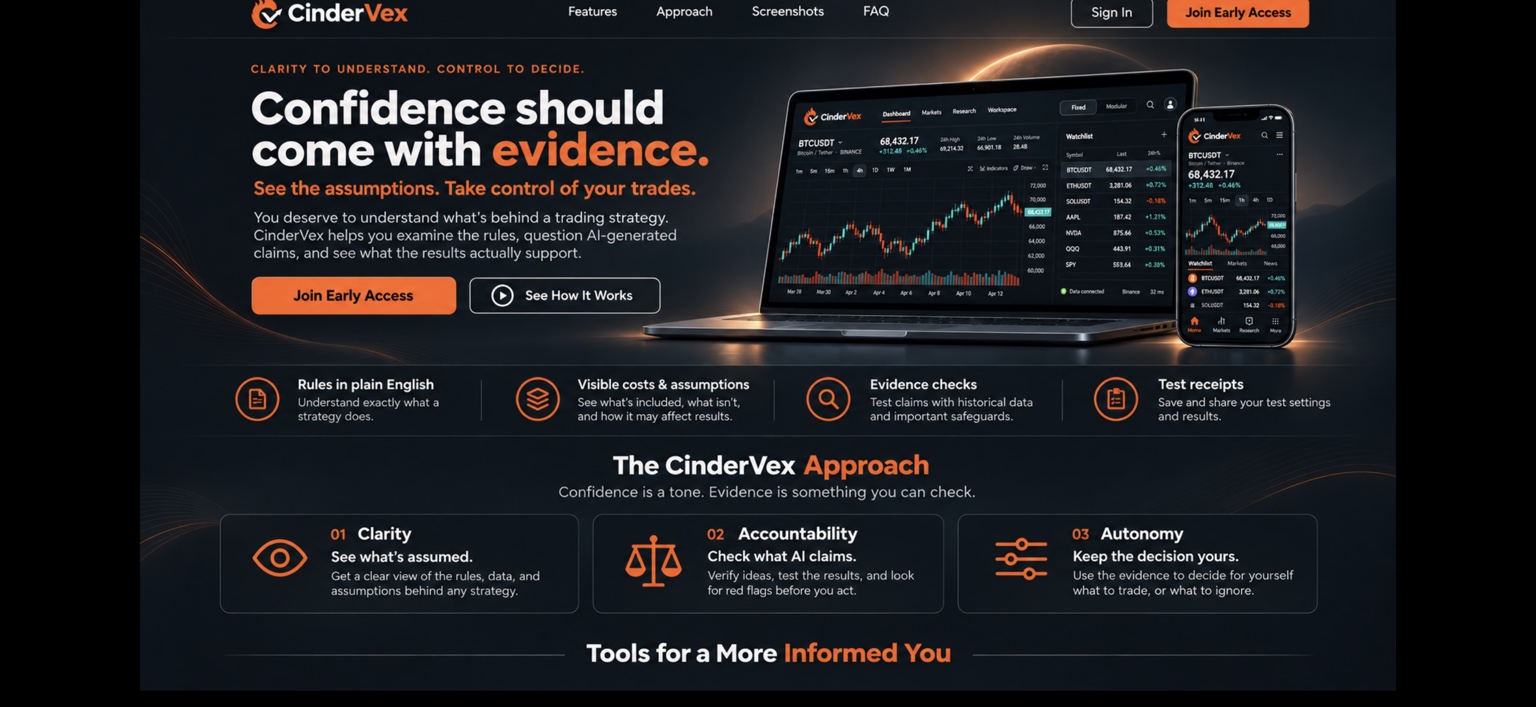
You deserve to understand what’s behind a trading strategy.
CinderVex helps you examine the rules, question AI-generated
claims, and see what the results actually support.
Understand exactly what a strategy does.
See what’s included, what isn’t,
and how it may affect results.
Test claims with historical data
and important safeguards.
Save and share your test settings
and results.
Make trading claims
something you can trust.
CinderVex is being built for everyday traders who want to understand an idea before risking money. Turn a social-media prompt, a chatbot strategy, or your own idea into written rules. Check the trades, costs, and assumptions. Keep the evidence—and the decision—yours.
Whether an idea comes from you or from AI, you deserve to know how it works. Explore its rules, see the assumptions behind a test, and consider what the result can—and cannot—tell you.
Get a clear view of the rules, data, and assumptions behind any strategy.
Verify ideas, test the results, and look for red flags before you act.
Use the evidence to decide for yourself what to trade, or what to ignore.
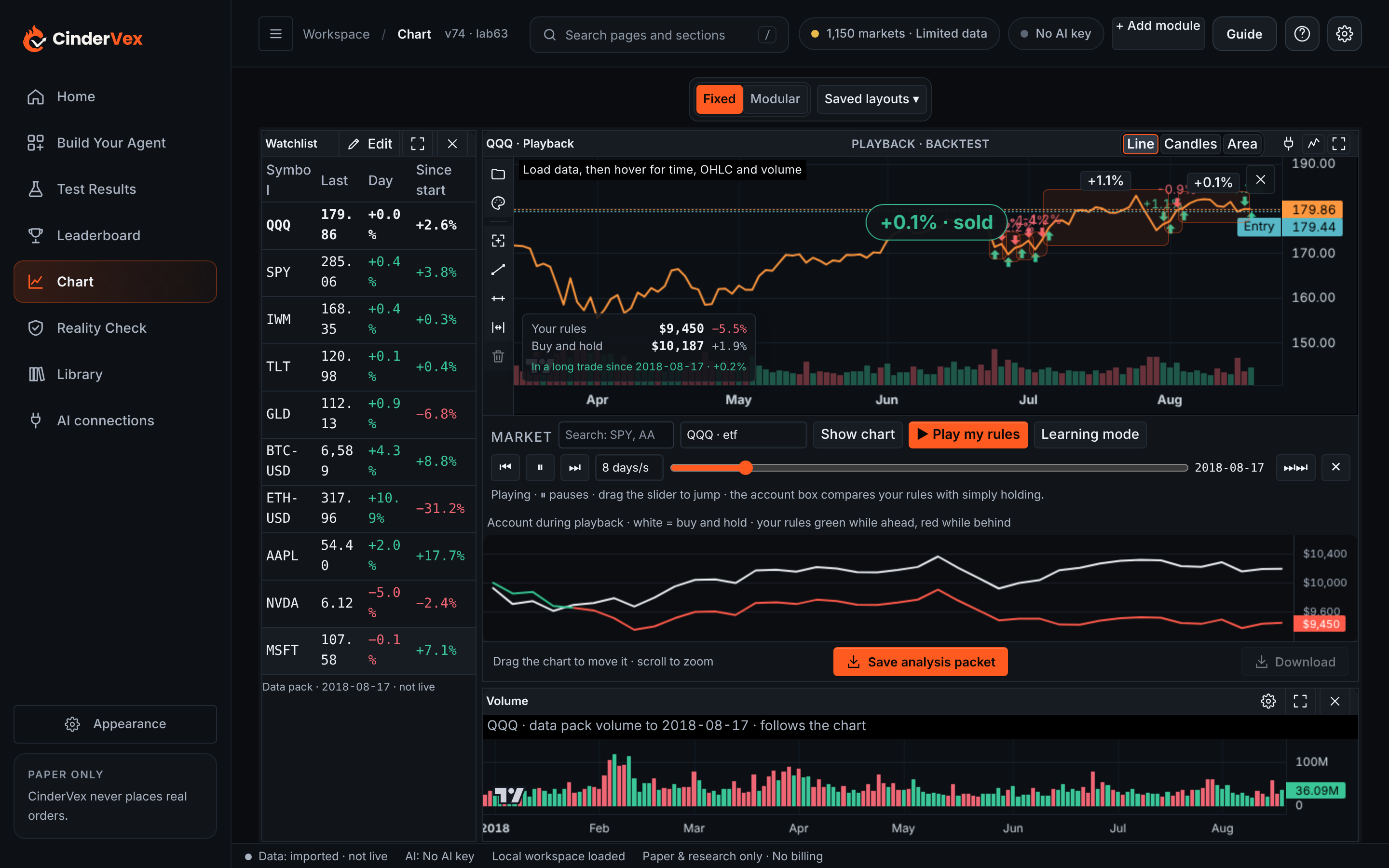
These original lab63 captures show the product workflow. Market history and engine calculations are from the development data pack; “Chatbot A” replies are made up for demonstration. They are not results from a real AI evaluation or proof of strategy performance. Desktop app shown; phone version planned.
Start with your latest Reality Check, explore ways to use the workspace, or go straight to building an agent. A new workspace prompts you to run your first check instead of showing invented performance.
The start-page workflow has been checked in development. This preview is not a public app release.
CinderVex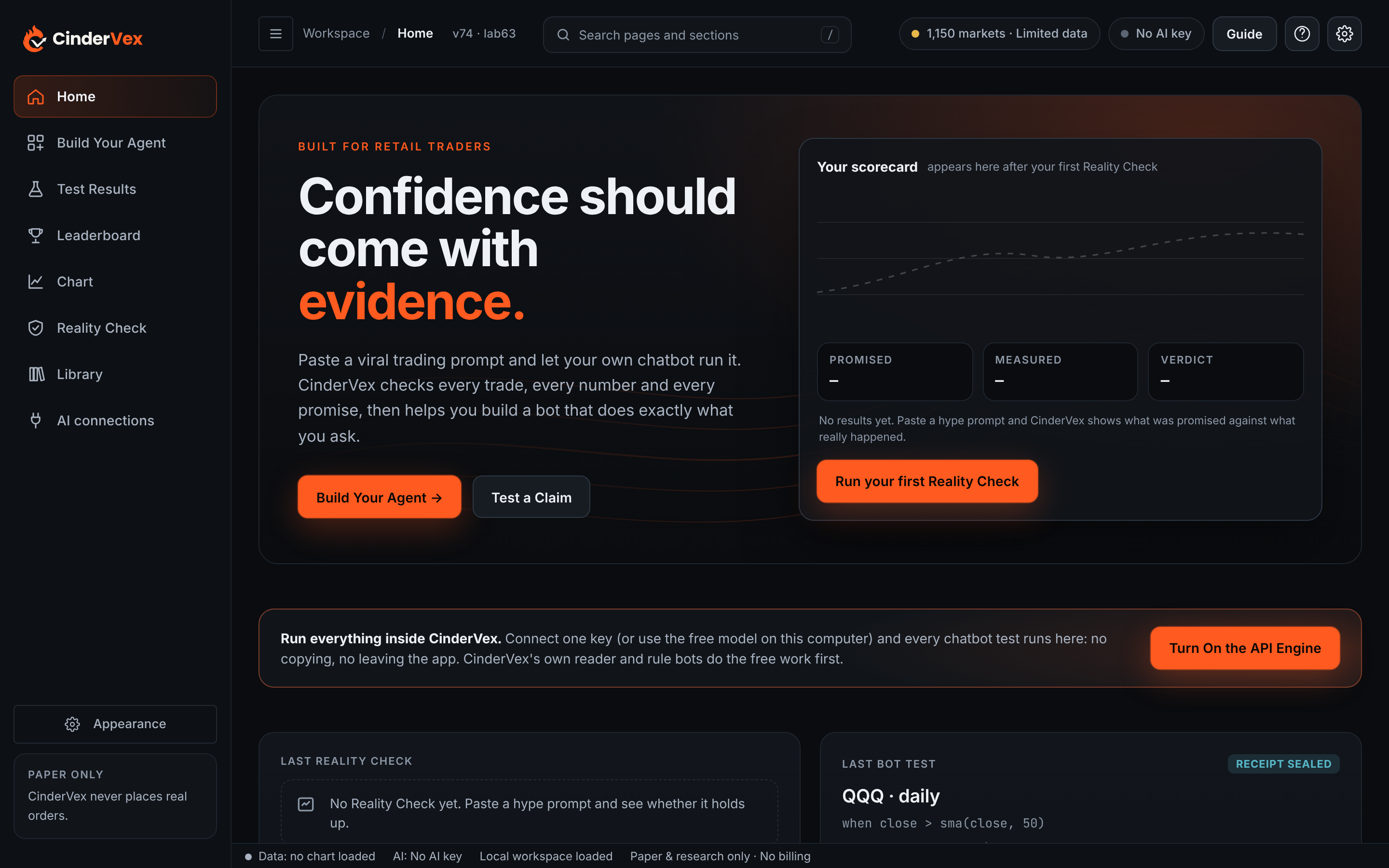
Choose your entry, exit, and risk rules, then read them back in plain English. Confirm that the test reflects the idea you intended.
Fees, slippage, and rule settings can change an outcome. Keep those choices visible and explore how sensitive the result is to them.
Look at losses, comparisons, and the limits of the evidence. An idea that falls short can still help you understand what to question next.
In development for research and paper testing only. No orders. Practice data cannot establish real-market performance. Historical tests depend on their data, assumptions, and costs; they do not predict future returns.
Replay market history one candle at a time. Watch your rules enter and exit trades as the test unfolds, with volume and account value beside a simple buy-and-hold comparison. Sample data · in development.
Our objective is to show when a claim holds up, when it falls short, and when there is not enough evidence to judge. The same standard applies to a chatbot and to our own rule bots.
Start with the exact viral prompt or strategy. Preserve it with the test, identify vague or unsupported instructions, and confirm the engine’s plain-English rules before running them.
Use the same market history, starting balance, costs, and risk limits. Compare after-cost results with buy-and-hold. Day-by-day tests limit what the chatbot can see.
Compare the claim with the measured result. Check missed or invented trades, wrong exits, and changes to settings. Repeat the message in a new chat to see whether the answer changes.
Check random entries, simpler alternatives, higher costs, small rule changes, and different time windows. Count the attempts and keep a receipt so a result can be checked again.
Report passing, failing, mixed, and inconclusive outcomes. An incorrect answer is evidence of an error, not proof of intent. Real-chatbot trials still need to be completed before we publish findings about viral claims or model performance.
The current engine uses one account ledger, configurable risk limits, and completed candles for signals. Standard settings use a 0.1% fee and 0.05% slippage on each buy and sell, with fills at the next candle’s open. Stop timing is disclosed; price gaps can exceed a planned loss.
Liquidity limits are not modelled. The bundled data omits delisted names and carries coverage warnings. Hiding market names and dates and rescaling prices reduces recognition; it cannot rule it out. Small samples, repeated tuning, and incomplete data can all make a result look stronger than it is.
Core checks have been reviewed on practice data or sample replies. The sealed Vault, forward tests, and live AI connections still need verification. Full per-run model settings and tool-access records, and fair speed and cost comparisons, remain open work.
CinderVex is in development. These are development priorities, not release promises. Timing and scope may change.
Manual agent building, plain-English Rule Cards, risk limits, test verdicts, receipts, luck checks, rankings, notes, and lessons.
Checked in development using practice data or sample replies. No public download yet.Chart and AI Connections improvements, better-fitting panels and menus, broader test baskets, and a smoother path from Agent vs Chatbot into its results.
Real-provider testing and local-model checks remain part of the work.Windows and Mac desktop apps, more timeframes, Python exports, expanded data including delisted markets, and a community library.
Data rights must be resolved. An independent security review is planned before public use.Trade Lab, partial take-profit, basket testing in Build, daily data updates, market mood tools, and optional CinderVex AI credits are on the roadmap. A phone version is a longer-term plan. Pricing, release dates, and included markets have not been announced. Live trading within CinderVex is a possible future direction if demand supports it, subject to further development and safeguards. Today the focus is research and paper testing.
Understand a trading idea before you trust it. See the rules in plain English, check the costs and trades, and decide for yourself what the evidence supports. You stay in control of the rules and risk limits.
Whether its numbers match the trades, whether it follows the rules it was given, and whether its answer changes when asked again. We’re building checks for missed trades, invented trades, wrong exits, and claims the results don’t support. The examples shown here use sample replies; real-model trials are still ahead.
Tools for examining trading ideas can be hard to access or understand. We want more everyday traders to be able to question a claim, test their own ideas, and see the reasoning for themselves. You choose what to test and what to do with the result.
Not today. CinderVex currently focuses on research and paper testing, without placing real orders. If demand supports it, we want to explore putting your rules to work directly inside CinderVex, without needing to export them. That would require further development, safeguards, and your explicit choice to enable it; no release date is set.
You can build and test rules by hand without AI. For chatbot testing, we’re developing copy-and-paste and optional connection routes. You choose whether AI takes part; provider connections are still being tested.
Yes. Ideas that make the app clearer, give you more control, or help you check a claim are welcome. Tell us the problem you want to solve and how you would use the feature. A dedicated feedback channel is planned; it isn’t available on this site yet.
Not yet. The app is in development. You can explore its screenshots and join the early-access list for updates.
Treat them as examples of how the app works. The screenshots show development tests, and “Chatbot A” uses made-up replies to demonstrate the checks. A historical test cannot promise future profit. We want you to see the limits as clearly as the result.
Follow the development of tools that put understanding and control in your hands.
Join the early-access list for updates. The app is still in development.